Printing Tips

Check out my printing tips if you're having problems printing to the right size
If you'd like to support this site and all the free things I post- please check out my Don't Eat the Paste Mandala collection coloring book for 9.99 at Amazon.
Showing posts with label jewelry. Show all posts

Thursday, March 26, 2015

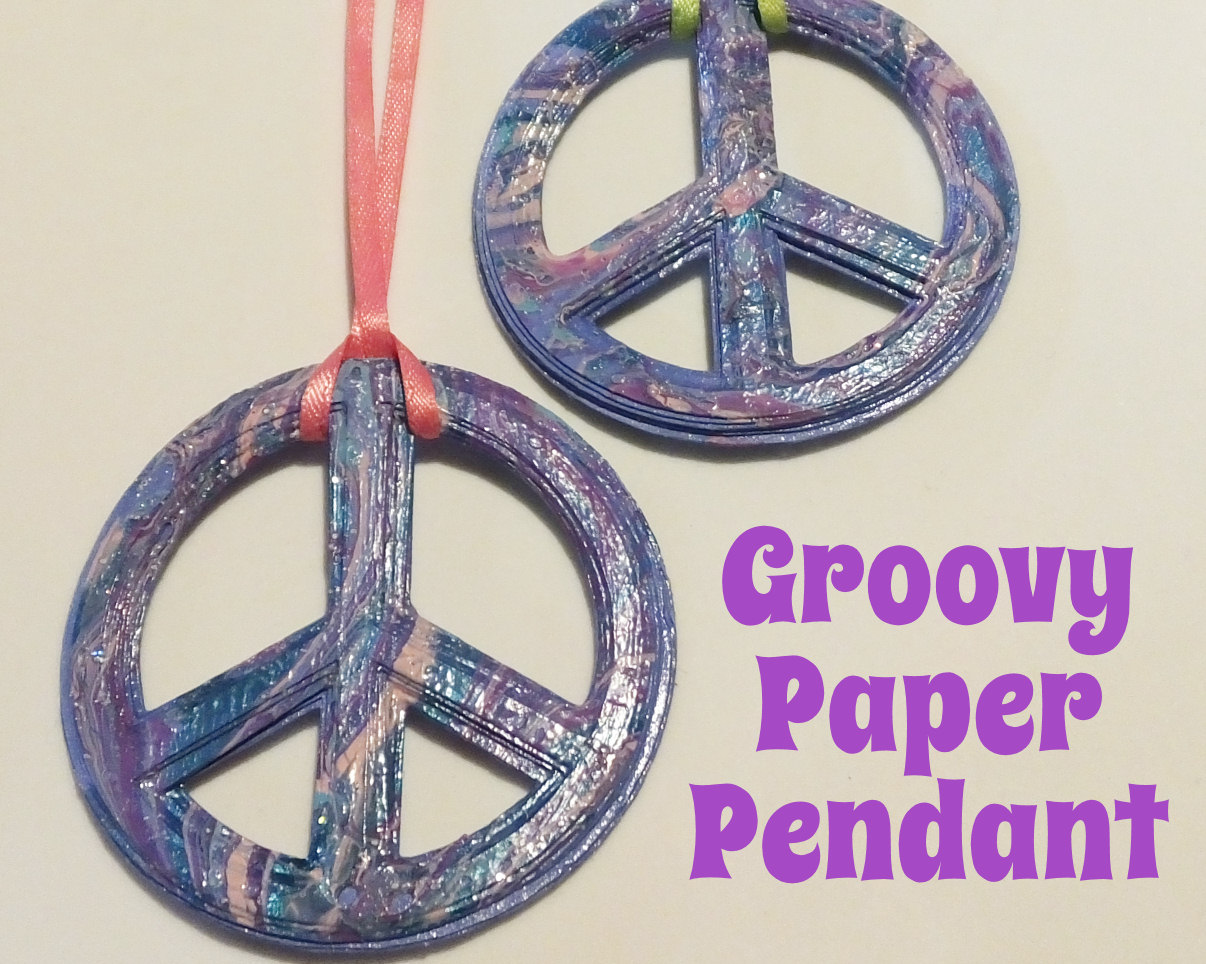
Groovy Paper Pendant

Instructions for a tie dye effect done with nail polish and templates for hand cutting or Cricut

Groovy right? Like I said before, I love peace symbols jewelry, but prefer handmade ones. The neat thing about this project is that you probably have all the supplies on hand.

There are 2 methods- I used the Cricut Explore Air to cut my pieces of peace (tried to resist the word play, failed.) The Cricut Explore Air is really nifty. It does all the wonderful things that the Cricut Explore does, it cuts, it draws, it embosses and scores, it uses the same online Design Space which makes it easy to upload your own images and cut, draw, emboss them. It has the same print and cut feature which let's you use your home printer from the interface to print a design then cuts it. But it's not chained to your computer- it works with Design Space application for iPad. I tried it! Sign in and all the stuff you have is still there. Cartridges you've loaded to your account, your own images, library items and things you've purchased, all there on the app. One of the really nice things about Cricut Explore is that you don't need to use vectors to create your own shapes. Upload images and shapes from your computer. Erase stuff, put new stuff in it, add text, it's all super easy.

So okay, done being all fangirl about the Cricut Explore Air (except that I really, really do love it)

The other method is obviously cutting out the pieces by hand. It's pretty easy too.

So how to make this groovy tie dye effect paper peace symbol necklace?

You will need:

  • Card stock
  • Scissors 
  • Mod Podge!
  • Nail polish in several colors
  • Bowl of cool water
  • skewer, chopstick or fork
  • Ribbon
  • optionally- Cricut Explore or Explore Air
  • template
So you can print the template on cardstock. Size it to make the thickest peace symbol the size you want the finished pendant to be. You can fit 2 to a page for smaller peace symbols.

Or upload this image to your Design Space account, don't preserve the image, you just want the cutting lines. Upload it as a simple image. It's a transparent PNG so there won't be anything to clean up. 

Cut your peace symbols. Glue them together from thickest to thinnest using Mod Podge. Getting them exactly centered isn't really necessary. I didn't, as you can see, I used blue card stock. 

Let the Mod Podge dry overnight, then do the back of the peace symbols and let that dry. 

Mod Podge IS water soluble, but getting it wet quickly and not letting it soak won't ruin a project. This is a good thing because the next part, the tie dye effect part, uses water. 

Water and nail polish!

Inexpensive nail polish is just fine for this project. If you want to make this a party project with friends, you can cut and glue a bunch of the peace symbols, 1 per friend, then have them each bring a bottle of nail polish. Using a few colors with good contrast works best.

Now grab a bowl and fill it with cool water, then open your nail polishes and drizzle them into the bowl. 

Yeah, really. 

Then I used a skewer to cut through the colors and swirl them.

Isn't that neat looking? Then you'll hold the paper peace symbol by the edge and quickly tap the whole front into the floating layer of polish. Lift straight out. 

Place it polish side up on a safe surface to dry, and if necessary use a bit of tissue to pull water off the piece. You don't want to touch the polish, just touch the corner of the paper to the water and let it wick it up. 

Let the nail polish dry. Put your ribbon on, add beads if you'd like! 

I was provided a Cricut Explore Air at no cost for review purposes for my non-biased opinion, I was not given any other compensation, and this is my honest opinion and experience. 

Amazon.com links help pay for my addiction to book and new cast iron pans for The Amazing Turnip Girl, so I appreciate it whenever people can use my links! 

Below is a link for the Cricut Explore Air Wireless Bundle, and my own coloring book full of peace symbols and other groovy things. 

Thursday, March 5, 2015

Crochet Pendant pattern

Crochet pendant pattern

I think I found a new favorite way to doodle with crochet while watching tv with my family, so if you like this crocheted yarn and thread pendant, let me know and I'll post more patterns later. The nice thing is they are quick to make, add a bit of color to an outfit and cost very little- they can be done with scraps of yarn and thread.

You will need:

  • small amount of worsted weight yarn 
  • small amount size 10 thread
  • size G crochet hook
  • steel size 7 crochet hook
  • needles to weave in ends
  • scissors

Stitch abbreviations:

  • Ch= chain
  • sc= single crochet
  • dc= double crochet
  • sl st= slip stitch
  • st or sts= stitch or stitches
  • repeat ** around means to repeat the instructions between the asterisks. 
With yarn and size G hook-
Make a magic ring or ch:
Rnd 1: ch 1 (does not count as first st), sc 6 times in ring or first chain, sl st in first sc to join. (6 sts)
Rnd 2: ch 1 (does not count as first st), 2 sc in each stitch, sl st in first sc to join (12 sts)
Rnd 3: ch 1 (does not count as first st), sc in same st, 2 sc in next st, *sc in next st, 2 sc in next st*, repeat ** around, sl st in first sc to join. (18 sts)

Break of yarn, weave in ends.

With thread and size 7 hook-

Magic ring or chain 6, join with slip stitch.
Rnd 1: ch 1 (does not count as first st), sc 12 times in ring, sl st in first sc to join. (12 sts)
Rnd 2: ch 3 (does count as first dc), dc in next st, ch 5, dc in next 2 sts, ch 5, dc in next 2 sts,ch 5, dc in next 2 sts, ch 5, dc in next 2 sts, ch 5, dc in next 2 sts, ch 3, dc in top of first ch 3 to join. (6 loops)
Rnd 3: ch 1 (does not count as first st), 3 sc in loop, skip next 2 sts, 3 sc in next loop, ch 3, 3 sc in same loop, *skip next 2 sts, 3 sc in loop, ch 3, 3 sc in same loop*, repeat ** 4 times, skip next 2 sts, 3 sc in loop, ch 1, dc in first sc of round to join. (6 ch 3 picots)

Rnd 4: Get the yarn circle, and hold it to the back of the of the thread flower. Remove hook from loop on flower, put it through one stitch on the outer rim of the yarn round, pull thread loop through the stitch. Chain 1, sc in st and the ch 3 picot on the flower together, sc in same stitch on the yarn round, 3 sc in next st on the yarn round, 3 in next st on the yarn round, sc in next stitch on the yarn round, sc in same st and the ch 3 picot on the flower together, sc in same st on the yarn round, *sc 3 times in next st on the yarn round, 3 sc in next stitch on the yarn round, sc in same st and the ch 3 picot on the flower together, sc in same st of the yarn round,*, repeat ** 2 times, 3 sc in next st of the yarn round, 3 sc in next st of the yarn round, sc in next st of the yarn round, join with sl st to first sc in round. 

Rnd 5: Ch 1 (does not count as first st), sc in same st, ch 3, skip next st, *sc in next st, ch 3, skip next st*, repeat ** around. Join final ch 3 with sl st to first sc to join. 

Chain 10, sl st in same sc to join. Break off thread, weave in ends.

Now you just need to make a cord for the necklace. I slip stitched a length for the cord shown, but you can also use monk's cord, a braided length, or even put it on a different kind of cord entirely. 

I hope you enjoyed the project! 


Sunday, September 14, 2014

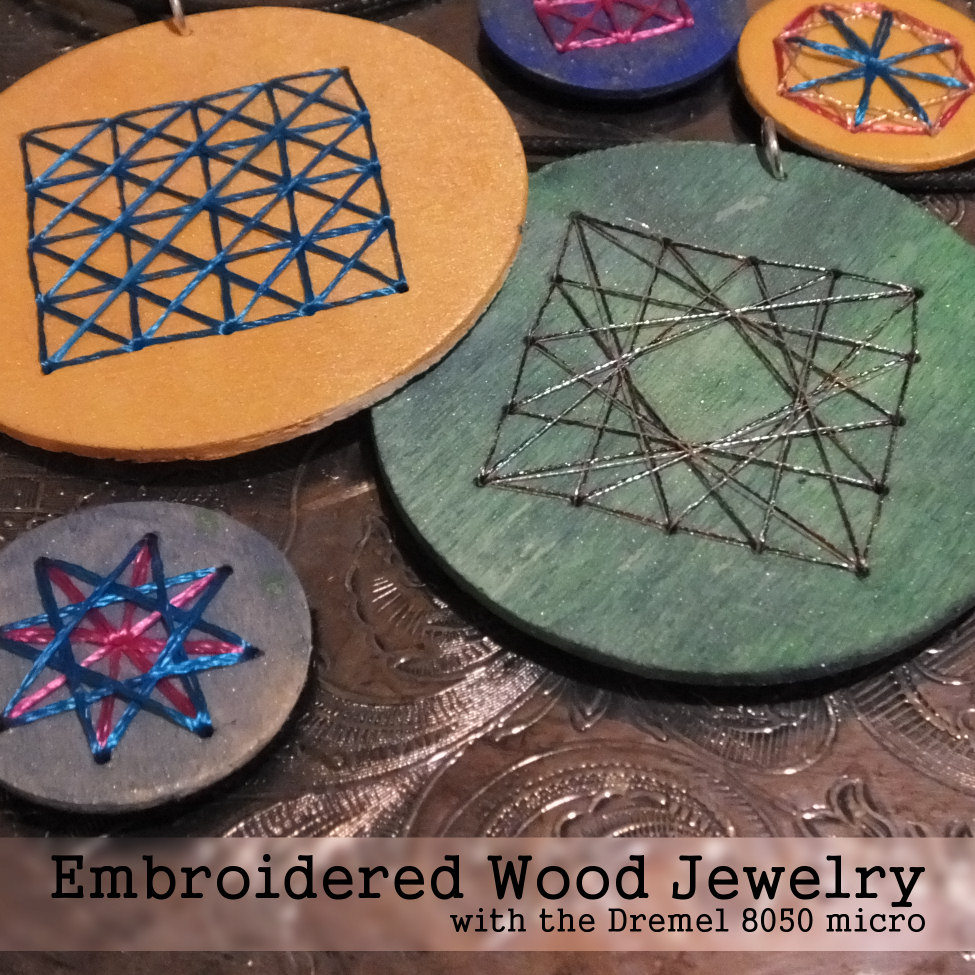
Embroidered Wood Jewelry using the new Dremel Micro 8050 (and why I LOVE this Dremel)


Embroidered Wood Jewelry tutorial using the Dremel 8050 Micro #MyBrilliantIdea #CleverGirls #sponsored
Dremel is awesome, you all know the. The first name in small power tools has the perfect new tool for crafters and hobbyists. The Dremel® Micro™ 8050 tool.

It looks like this, and it's available in all the usual places. Home Depot, Amazon, and it's 89 dollars USD.
So what makes it the perfect tool for hobbyists?

  • It works with standard Dremel bits, grinders, burrs and collets
  • Lots of power in a cordless that can be left on the charger until needed- it automatically stops charging when the battery is full. 
  • Light weight and ergonomic design is easy to hold and control
  • TASK LIGHT! When it's in use, it has a little directed LED that shines right on the project to really see what you're doing. 
  • It does everything you expect from your Dremel Rotary tool, it drills, grinds, sands, sharpens, engraves and carves
In fact, the only thing that's not perfect about it in my family is that we have only one. We plan to remedy that soon. My daughter loves it for making hard wood knitting needles. She whittles down to the basic shape for the point, then uses a sanding drum to finish shaping for a nice taper. My husband thinks it's the best thing in the world with a small collet and drill bit to put nice neat holes in leather without having to line up punches. Using the 8050 Micro, he can mark where the holes need to be then zip zip zip and they are done. My son likes engraving glass.
It's designed to fit well into small areas, and to work on small projects.

Check out Dremel on TwitterFacebook and Pinterest for lots of ideas and projects.

To make the jewelry shown, you'll need a Dremel 8050 Micro, a collet and 1/8th inch drill bit- both are available from Dremel, and if you want to bevel the edges, a sanding drum.
You will also need:
Wood disks, embroidery floss- this is a great use for specialty floss, paint, glue, needle to fit the floss, and jewelry findings. 

This is a good project for craft nights and if you pre-drill, a fantastic project to do with children because there are so many ways to embroider designs and paint the disks.


Plan your holes. I went with a couple layouts for the small disks, and one layout for the large pendant disks- I made marks on one of the wood disks.
Then instead of marking each disk, I taped a few together- these are fairly thin disks of wood. 
Then drilled the holes. So fast, so easy.
Now, you paint them. Remember to contrast the paint with the floss so the floss shows up well, and start stitching. The fun part is that the same hole layout can be used in different ways. 
Spread a layer of glue on the back to seal all the knots and thread. You can back the disks with paper, felt or even another disk. Then attach all your findings. I'm going to glue the small ones to barrettes and ring blanks. The large ones are fun pendants. 

Dremel wants to celebrate its fans’ brilliant projects, work and ideas! Now through October 12, share, tweet or post photos on Facebook, Twitter and Instagram that depict your brilliant ideas using the hashtag#MyBrilliantIdeaSweeps for the chance to win weekly prizes, including free tools and handmade gifts, or the grand prize: a custom-engraved Honda scooter and a Micro 8050. Visit www.facebook.com/dremel for rules and to learn more.

I was selected for this opportunity as a member of Clever Girls Collective and the content and opinions expressed here are all my own.

Saturday, January 19, 2013

DIY Glitter Photo Pendant


Tutorial- glitter photo pendant

This little pendant is kind of like a locket, except it doesn't lock, and it's pretty quick to make except for curing time. Mine has photos of my kids in it.


You will need:

  • Wood shapes- I used hearts!
  • drill with a 1/8 inch drill bit and something safe to drill on
  • 220 grit sandpaper
  • optional- painter's tape
  • paint
  • fine glitter
  • decoupage medium
  • foam brushes
  • Photos or pictures for the inside
  • 1/8 inch hole punch
  • scissors
  • ribbon
  • large jump ring- either handmade or commercial
Quick notes- I used my Fiskars Craft Drill, it's hand powered, quiet and easy to use. The glitter is Martha Stewart -Garnet, and the jump ring is made from 18 gauge copper using a knitting needle as a mandrel. The hearts were from a mixed bag of heart wood shapes.

You'll need two shapes the same size and shape, so if you have a bag of shapes, sort through and pick out 2 the size you want to make the pendant.

Then it's time to drill them. I used painter's tape to wrap them securely together. That let me drill both pieces at once to have the holes in the right place, plus wrapping them in tape helped keep the soft wood from splitting. You can also drill one, then use it to mark the other one to drill it.
Now take them apart if you've taped them together, and sand both hearts smooth. Then you'll paint them. They need to be painted and glittered in mirror image to each other so there is a front and back. Let the paint dry, then put on a coat of decoupage medium and GLITTER!
After the decoupage glue has dried, add another coat to seal the glitter so the finished pendant isn't leaving glitter everywhere. Let dry.

Then it's time to start with the photos. Measure your hearts to resize photos to fit, or draw little pictures on paper or cut images from a magazine. It's your choice, it's your necklace. Trace the hearts on the image, paying attention to where the holes will be so you don't accidentally wind up with a hole in the wrong place. Cut out just inside the outlines using the scissors. Place the heart over the image, and mark where the hole is to punch it. Repeat for the other image remembering they need to be mirror images for hole placement.

Decoupage the unglittered sides of the heart with the images.  Make sure the holes are clear using some sort of needle type tool.


Let the hearts cure,  Over night should do it.

Then you just need to connect them with the jump ring and hang from a ribbon!

You aren't limited to just hearts of course, stars will work. If you wanted, you could make a mini book by cutting pages to fit, punching holes and using a bigger jump ring. 

The cups in the photos are made by Silverbear Sundries

Saturday, July 21, 2012

Etruscan Inspired Mandala to Color

Etruscan Inspired Mandala


The image above is the small jpg version of the mandala. Why isn't there a colored version? Because I've spent hours drawing it and just don't want to spend another few hours coloring it right now!

The Etruscan civilization was in Italy, from about 800 BC until it was assimilated by Rome in 1 AD. A few years ago, I had the pleasure of seeing some gold Etruscan jewelry as part of a traveling exhibit about gold. What makes the jewelry absolutely remarkable for the era is the sheer amount of detail that goes in to it. While the techniques themselves are fairly basic, the fine detail and encrusted look of the gold jewelry is astounding. They would use wires and granulated balls of gold on sheet metal, soldering each piece in place.
Like a lot of other cultures and art, there were a lot of floral motifs, as well as radially symmetrical geometric designs. Like mandalas. 
I've worked in silver, and a little bit in gold. Using modern tools, and modern techniques, I wouldn't have the patience for the kind of very full, very textured look of Etruscan jewelry. Pretty much, I just know enough to really appreciate those long gone artists. 
Click on the image above, and the one below for larger versions to print.
Here's the large PNG version:
Large mandala


Friday, June 8, 2012

Rain Cloud Felt Pin

This isn't a step by step how to, more an overview.

I made this pin last night. The bead/pendant hanging from the bottom is from Cousin Corporations Jewelry Basics Acrylic series. It's a bit over an inch long.

You will need:

  • White craft felt
  • Embroidery floss
  • colored sequins 
  • 2 small seed beads for the center of the eyes
  • tear drop shaped bead or pendant
  • large seed beads- those are from an E bead mix
  • a scrap of plastic (milk jugs are great for that!)
  • pin back
  • small amount of stuffing
  • scissors
  • thread
Take a piece of white craft felt about 6x2 inches, fold it in half so the 2 inch sides meet and cut out a rain cloud shape. I just freehanded a rounded shape. 

I'm not a fan of big bulky knots for small projects like this to keep the thread from pulling through the felt, so what I do is tie the end of my thread in a knot big enough to keep it from pulling through a light colored sequn, and use light sequins on the back where the knots will be. 

Embroider the face and finish off the embroidery with another sequin on the back. I also used two blue sequins that matched my thread for the eyes, held in place by seed beads.

On the back, stitch the little drop with the beads and tear drop, then make a running stitch to where you want the pin back to be. Cut a small rectangle of felt that will fit over the center bar of the pin back, and stitch it in place over the pin back.


Cut a small piece of plastic to sandwich between the two layers of felt. Stitch the felt pieces together with a blanket stitch around the plastic stopping about 3/4s of the way around to very lightly stuff it on the front side. Finish stitching.

Super easy! And you have a cute little rain cloud pin.

Friday, May 25, 2012

Recycled thread wrapped donut pendants

Recycled Thread Wrapped Donut Pendant

We don't have a Target locally anymore, and my medicine doesn't come with these nifty personal identification rings. A friend of mine who knows how much I love to craft with reclaimed things sent me a bag of them. 

They seem to be made of silicone, so the rings have some give. The base ring for the pendant above is blue. It's thread wrapped and color blocked, two popular trends. 

You will need:
A medicine personal identification ring
Embroidery floss in the colors you want
tapestry needle with an eye big enough for 6 strands of floss
scissors
cord

Cut a strand of floss that's at least 2 feet long, and tie it loosely around the ring.

Start wrapped the floss around the ring. You want to lay the wraps right against each other so they cover the ring completely. When you've finished the area you want to wrap, thread the needle with the floss, and then slide the needle between the floss wraps and the ring. Pull the floss under to lock it into place. Trim thread close, then tie the next color loosely on.
For the smaller wrap areas, rather than trying to neatly end off a small area, I added floss into one of the longer sections, holding a 2 foot length of floss and wrapping over it, then letting the end dangle until I finished the main color blocking.
After the ring was covered, I put the needle on the strand of floss and wrapped over a small section, then passed the needle between the floss and ring to come out in the next area I wanted a small wrap section.

It looks neater if you always go backwards through the section just wrapped, so that floss went back and forth a few times. The silicone has enough give that it worked well and didn't show very much.


Add a cord. The one I used has a simple overhand knot over the donut and sliding knots for adjustable length.


Monday, February 14, 2011

Handmade copper buttons


First, the legal stuff. Most interpretations of  the statutes applicable to defacing coins in the U.S.A. are applied to mean if you deface currency for fraudulent purposes. Such as turning a 1.00 dollar bill into a 10.00.  Which is why there are so many penny pressing machines in your local tourist attractions. In other countries, the law varies. These buttons are not being made for fraud. They are nice, primitive buttons that can be used to a nice effect in sewn, knit and crochet projects. For more information, check out this site here.

At the time of this writing, copper pennies, that is, 1981 and earlier, are worth 3¢ each. Copper keeps rising in price. So I'm in the habit of checking all my pennies as they come in and separating out the copper ones. This is also a good idea if you're pressing pennies in penny machines. That way you'll have a piece that's nearly all copper!

To make these is so simple. Using a bench block or similar surface, a hammer, and a metal punch they work up very fast. If you want very shiny pennies, you can shine pennies with a bit of ketchup. Really truly! Or vinegar and some salt, or even toothpaste.
I like the rough way these look. I have my husband hammer them flat very quickly and he hits at odd angles and mars up the surface a bit. With more deliberation they come out rounder without the scars from the hammer, like the buttons on the apple cozies above. I polished the pennies before hammering them and I was fairly careful how I hammered them. So they turned out very smooth and a bit shinier.
So, you put the penny on the block, and hammer it flat. Then comes the fun part. Punching the holes.
Using this two-hole metal punch  from Rings and Things, put the flattened penny in throat for the smaller hole. The throat on the smaller side of the punch is deeper than the throat for the bigger hole. Then you screw down the punch and it punches out a little hole. This works very easily, you don't need much strength at all to twist down the punch. Pull the penny out and reposition it to punch the second hole. For mine, it worked perfectly to put the edge of the penny all the way to the back of the throat then punch a hole, then for the other side, just turn it around and put the opposite edge against the back of the throat of the punch.
Rings and Things also carries the bench blocks, more professional hammers than the one I used, and dapping blocks that could be used to make a more domed button. The also carry lots of copper shapes and sheet copper if you don't want use a penny.
The two-hole metal punches can also be used on pressed pennies to make pendants or keyrings of them.

Monday, January 10, 2011

Delicate Wire and Chain Earrings


If you look at the right hand side of my blog, you'll see a fairly short list of links to sites I like. More links are under the links tab at the top of my page. 
One of those links is Auntie's Beads and it's been there for almost as long as this blog has been up. Because the site has good prices and some of the best "How to bead" videos I've seen on YouTube. Look on the side bar of their page under resources for those. 
So when they asked if I wanted to use some beads and post a project made with them, I jumped on the chance. 
They sent 5 sparkly strands of faceted crystal beads. 
The first thing I made was the pair of earrings above. They are very simple to make, have a ton of sparkle and shine, and the design can be changed up to suit other looks very easily by changing the metal and color of the beads. So if you used gunmetal with jet and metallic plum it would be very dark and gothic. Copper with bright colors would be a great Bohemian look. The earrings are very light to wear and have a lot of swing.
I work with my wire right on the coil or spool so I have less waste. Check out their glass beads page for lots of colors and options.
You'll need:
5 inches of chain
earring hooks
15 inches of wire- I used 24 gauge sterling
2 head pins
beads! 
I used 
4 6x8mm rondelles
6 4mm bicones
4 6mm bicones
10 3x5 rondelles
4 4x6mm rondelles

-basic wire working skills-

Cut the chain into 8 lengths, 4 at 3/4 inches, 4 at 1/2 inch 
On a headpin, string on a 6mm bicone, 3x5 rondelle, 4mm bicone. Make a wrapped loop on top. Repeat for the other headpin
 Cut off 2.5 inches of the wire and make a wrapped loop. String on a 3x5 rondelle, 6x8 rondelle, 3x5 rondelle, Make just the loop part for the bottom, don't wrap it yet. Add on 3/4 inch chain, 1 decorated head pin, 3/4 inch chain. Finish loop.
Cut off 3 inches from the wire. Start a loop on the end, slide that on one 3/4 inch chain, and finish the wrap. String on 4 mm bicone, 1/2 inch chain, 4x6 rondelle, 6x8 rondelle, 4x6 rondelle, 1/2 inch chain, 4 mm bicone. Hold the beads in place while putting a soft curve in the beaded wire. Because of the shape of the beads, you need some "slack" in the wire or extra space. If you wrap the second loop without curving the wire first, you might not be able to curve it. Start the loop at the end, slide the other 3/4 inch chain on the loop, finish the wrap.
The bottom piece is done with a 2 inch piece of wire. Make a small loop on one end. Slide the half inch chain on the loop, finish the wrap. String on 1 3x5 rondelle,1 6mm bicone and 1 3x5 rondelle. Make loop, slide the other chain on the loop, finish the wrap. Repeat for the other earring.
The basic technique is pretty adaptable and makes a great project while watching tv. If you wanted, you could skip the head pin entirely and add more layers of chain sections for longer, even more sparkly earrings.

The cup I displayed the earring on is part of my personal collection. I love my no handle cups for tea or chocolate on cold days! This one was made by Ember Haynes of Silverbear Sundries.


Tuesday, September 28, 2010

Bat Cane- art and instructions


This is my spare cane. I picked up an inexpensive walnut cane from the grocery store to have as a back up, and couldn't resist decoupaging it. 

First I measured the circumference of the cane, which was right about 3 inches. Then I created the design. 5 inches long sounded about right to me. Click on the image to download the full sized 300 ppi version.
I printed that on a decorative paper. My choice was a coffee leaf paper that TerraCycle used to make and that I've been hoarding for special projects. A mottled, marbled, or other light colored design looks good for this. After printing, spray the design with a sealer.
Pull out the glossy Mod Podge. Cut out the design and check to make sure it wraps with the ends just meeting or just barely overlapping. Cover the back of the image with Mod Podge and glue it in place on the cane.
Then I cut strips from some of the remaining decorative paper, and glued them on to decorate, and to finish the edges. 
Cover the whole thing with a light coat of Mod Podge, going beyond the edges a bit to seal the edges. Let dry for a bit, repeat, repeat.
Let the Mod Podge cure for 24 hours, then I added an extra coat of sealer to make it very durable. I used a polyurethane spray because the color of the paper means some yellowing won't mess up the design. I sprayed it, let it dry for 10 minutes, sprayed it again,, let it dry for 10 minutes, sprayed it again. Using a high gloss polyurethane, it's very shiny! Let the polyurethane cure for 24 hours.
End result is a Halloween cane for about 10 dollars. If you don't have polyurethane or Mod Podge, it may cost a little bit more initially, but you'll be able to use them on canes for other holidays or canes to match dressy outfits. 
Other recent projects include this tassel necklace. You can find instructions on Beadwork at BellaOnline.

And these copper projects. The ankhs I made last week. The beaded messy necklace I made last night. They are made in copper and darkened with liver of sulfur. I wiped off the excess with a 3m synthetic steel wool pad. First time I used one, if you click on the image you might be able to see a couple bits of fluff I missed, but compared to regular steel wool on wire projects like this, there was very little shred. The size is a nice one for jewelry projects as well. Tiny little rectangle shaped pads!


Tuesday, June 22, 2010

Reclaimed rubber bracelets


The people at Alaska Bicycle Shop have been very kindly saving damaged bike tire inner tubes for me. When I went to pick them up they had 37 in a basket for me. More than enough to make lots and lots of bracelets, but given how versatile this material is for crafting, I suspect still not enough.
If you have a bicycle tire inner tube from your own bike, or can get them from a local bicycle shop or friends, these bracelets are very fast and easy to make.
You will need:
A prepared piece bicycle tire inner tube
snaps and snap setter - I used Dritz snaps
scissors or craft knife- I used tiny sharp scissors that aren't quite sharp enough anymore for my beading thread, but still in fine shape for the rubber
a light colored gel pen
rubbing alcohol
stencil

To prepare a piece of the inner tube, cut off a length that's an inch longer than the bracelet you want to make. Cut it open and with hot soapy water and a dish scrubbie, scrub off the white powder residue from the inside of the inner tube. Let dry.

Prepare the stencil. I just printed it out on paper and cut out the pieces. Click on the image for the full sized version. You may need to modify it somewhat for the width of the inner tube you are working with, making the flower petals a little closer or maybe a little bigger. 


Using the stencil, trace the design on the back of the inner tube using the gel pen, then cut out the negative spaces. 
Cut around the whole design leaving about 3/8th of an inch border around it and tabs on either side to attach snaps to. Double check the size on your wrist before cutting the tabs!
Attach snaps following the instructions on your package of snaps. The gel pen marks from the back can removed with a bit of rubbing alcohol.
On, these look almost like tattoos. The rubber may try to curl some when it's lying flat, but once it's on it's flat. Some of the inner tube may have printing on it, and that adds a nice bit of character to these sorts of bracelets. My son plans to do some mystery braid bracelets using the same material. Absolutely one of the best reclaimed materials I've ever worked with.

Comments locked because of spam. Sorry about that! 

Tuesday, February 23, 2010

Fortune Cookie Earrings with printable fortunes

On Valentine's Day my husband brought me to a little Chinese restaurant we used to go to a lot when we were first dating. When we opened our fortune cookies, I had to laugh because his fit him so perfectly. I put both fortunes in my purse planning to make earrings with them.
 
I have a little card laminator. It's not much,but I use it for small crafts and for those occasional laminating jobs my dad asks me to do for him. In the past, when I'd done laminated paper for necklaces and such, I trimmed it with enough extra laminate on top to punch through just the layer of laminate. This time I used 2 hole punches. My 1/8 punch on the fortunes and fortune cookies, then after laminating, my 1/16th punch in that hole so it was still sealed around the hole. Sort of like this. The laminate is the teal outline, the paper is the black outline.

It worked out very well. Then I used simple wrapped loops and chain to put the earrings together with some pretty pearls and sterling bead caps.
You could use your own fortunes and pictures of fortune cookies from the internet. I drew the fortune cookies I used my earrings. I think it makes a nice sentimental keepsake. Packing tape would probably work instead of laminate but it won't be as stiff. Cut out the fortune cookie and punch all the pieces before arranging them in a laminating sleeve and laminating them, then trim the laminate around the images leaving a bit of a margin to keep it all nicely sealed.
I used the same technique to make this double sided pendant for my daughter using trading cards from the Star Wars Science Meets Imagination exhibit as our local museum.
 
My handy dandy 2 inch circle punch and then trimmed the sides so it fit my laminating sleeves a bit better.  
I had to run it through the laminator twice to get a real good seal because the two layers of card were a bit thick, but she's very happy with how it turned out.
You can download my fortune cookie art and two silly fortunes here